Stock Keeping Unit (SKU)
What is a SKU?
A SKU (Stock Keeping Unit) is a unique alphanumeric code that identifies a specific product in your inventory system. It's how your ERP knows the difference between the blue widget and the red widget, the 12-inch version and the 18-inch version, the one that ships from Ohio and the one that ships from Texas.
Simple enough, right?
Here's where it gets complicated: your SKU for that blue widget is WDG-100-BLU. Your customer calls it "BWS-100." Their competitor calls it "BLUE-WIDGET-STD." And that one guy in purchasing just emails "the usual blue ones."
They're all talking about the same product. Your ERP only understands one of those codes.
Why SKUs Matter More Than You Think
Every order that hits your system needs to resolve to valid SKUs before anything ships. No SKU match, no sales order. No sales order, no pick ticket. No pick ticket, no shipment.
Your SKU is the translation key between what customers ask for and what your warehouse actually picks. When that translation breaks down—wrong SKU, invalid code, ambiguous match—everything downstream breaks with it.
And here's the thing most people don't realize until they're knee-deep in order entry: every company has their own SKU system. There's no universal standard. Your SKU-100-BLU means nothing to anyone outside your four walls. Your customers have their own part numbers. Their customers have different ones. Everyone's speaking a slightly different language.
This is why someone on your team spends hours every day playing translator.
What Makes a Good SKU System
A well-designed SKU tells you something useful at a glance. The best ones encode product attributes directly into the code:
Product category: First few characters identify the product line
Variant details: Size, color, material embedded in the code
Location or source: Where it's stocked or manufactured
So WDG-100-BLU-OH might be a widget, 100-series, blue, stocked in Ohio. Your team can read it without looking anything up.
The nightmare scenario? Legacy SKUs from 1987 that follow no pattern anyone remembers. Codes like "X7749-B" that could mean anything. SKUs created by someone who left the company a decade ago, and now you're stuck with a numbering system that makes sense to exactly zero humans.
The other nightmare: SKU proliferation. You started with 500 products. Now you have 47,000 SKUs because every color/size/packaging combination got its own code. Your cross-reference spreadsheets have cross-reference spreadsheets.
Where SKU Problems Show Up in Order Processing
The SKU itself isn't the problem. The problem is getting FROM what customers send TO the SKU your system needs.
Customer part numbers: Your biggest customer has used "BWS-100" for years. That's not your SKU—it's theirs. Someone has to translate it every single time.
Vague descriptions: "3 cases of the blue ones" isn't a SKU. Neither is "same as last order" or "the widget we discussed on Tuesday." But that's what shows up in emails.
Unit of measure confusion: Customer orders 10 cases. You sell by the each. Is that 10 eaches or 120 eaches? The SKU doesn't tell you—your cross-reference table (if it's accurate) does.
New products and customers: Every new relationship means building more translation tables. Every new product means updating every customer's mapping.
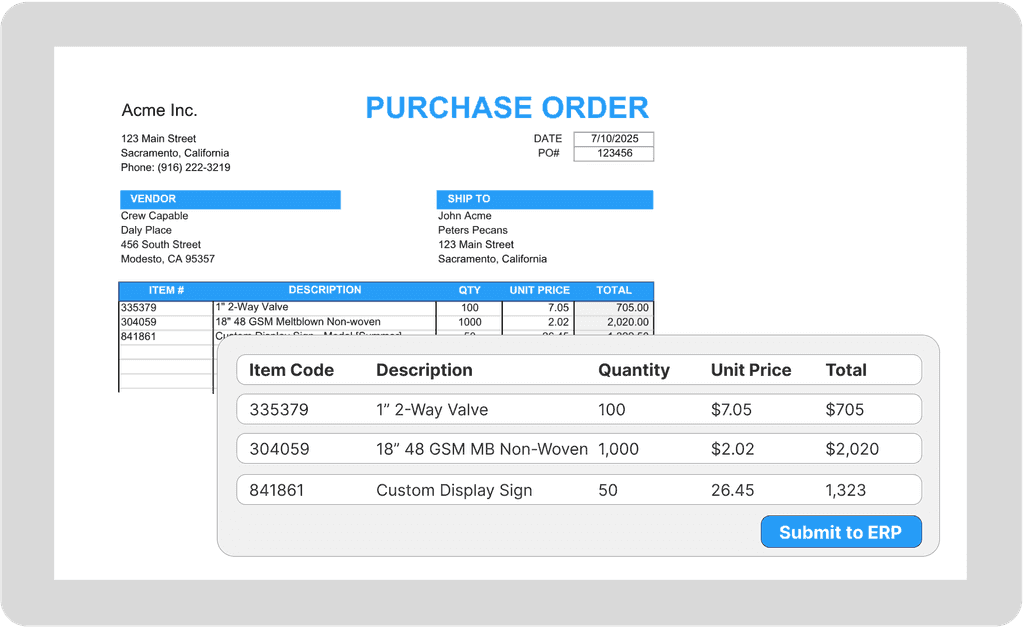
This translation problem is exactly why AI-based order automation exists. Platforms like Crew Capable are built to recognize that "BWS-100" and "blue widget standard" and "the usual 12-inch blues" all refer to the same product in your system—without maintaining endless cross-reference spreadsheets.
Tired of manually translating customer part numbers into your SKUs? Crew Capable automates the matching—recognizing customer codes, vague descriptions, and format variations without endless spreadsheet maintenance. See how it works with your actual orders.