Minimum Order Quantity (MOQ)
What is Minimum Order Quantity (MOQ)?
Minimum order quantity (MOQ) is the smallest quantity of a product—or total order value—a customer must meet to place an order. Companies set MOQs to maintain profitability on small orders, meet manufacturing batch requirements, or optimize shipping and handling costs.
Enforcing it? That's where things get messy.
Customer sends a purchase order for 3 units. Your MOQ is 25. Now someone has to call them, explain the minimum, negotiate whether they want to increase or cancel, re-quote if they add products to hit the minimum, and process the revised order. By the time that's sorted, they've called your competitor who apparently doesn't have MOQ requirements.
MOQ enforcement sounds like a simple rule until you're the one making 30 awkward phone calls a day.
Why Do MOQ Violations Keep Happening?
The obvious answer: customers either don't know about your minimums or don't care. They need 3 units. They order 3 units. Your internal requirements aren't their problem.
But the real answer is more complicated.
Your MOQs aren't simple. Product A has a 10-unit minimum. Product B is 25. Product C varies by customer tier—distributors can order 5, but retail needs 50. Product D has a dollar minimum instead of a unit minimum. Product E has no minimum at all because it's a new item and sales wanted to "make it easy to try."
Now look at how this lives in your system. Product A's MOQ is in the item master. Product B's is in the customer price agreement. Product C's varies by the pricing tier in your customer record. In NetSuite, you're checking the item record, then the customer record, then maybe a pricing rule. In SAP, it's the material master plus the customer-material info record. Your team is checking multiple places—or worse, a spreadsheet someone maintains on the side.
Now ask your order entry team to remember all of that while processing 150 orders before noon.
They can't. They're not supposed to. But when MOQ enforcement is manual, that's exactly what you're asking. Every line item on every order needs a mental check: "Does this meet the minimum? Which minimum applies to this customer? Did we change it recently?"
Nobody has time for that. So violations slip through. Not because your team is careless—because the system makes perfect enforcement impossible.
The temporary exceptions make it worse. Promotional MOQs during trade shows. New customer grace periods. Year-end "just ship it" desperation. Each exception is a trap for future orders when someone assumes the old rules still apply.
What Happens When MOQ Errors Slip Through?
When you catch an MOQ violation at order entry, it's annoying. When you catch it at fulfillment, it's expensive.
Fulfillment tries to pick the order and realizes they can't break a case to ship 3 units when your MOQ is 25 and you only sell full cases. Now what? Ship partial and short them? Ship the full case and hope they pay? Hold the order and call the customer?
Every option is bad. Every option costs time and money. And every option makes your customer question whether they want to keep ordering from you.
The margin erosion is real too. You set that 25-unit MOQ because orders under 25 units lose money after you factor in picking costs, shipping minimums, and invoice processing. Every MOQ violation that ships is an order that costs you more to fulfill than you'll make on the sale.
The worst scenario? Accepting an order, shipping below MOQ because "we can't make them wait," then trying to explain to finance why that account's margin is negative.
Or the customer service nightmare where you reject an order after already confirming it. Customer placed the order. Got a confirmation email. Planned their inventory around it. Then you call to say actually, no, you can't have what you ordered. Good luck keeping that relationship intact.
How Can You Catch MOQ Violations Before They Become Problems?
Manual checking doesn't scale. You know that. The question is what replaces it.
Basic automation applies hard rules. Order below MOQ? Rejected. Problem is, hard rules don't handle nuance. That customer who's been with you for 15 years and occasionally orders 20 units when the minimum is 25? Your automation just told them no without any human judgment involved.
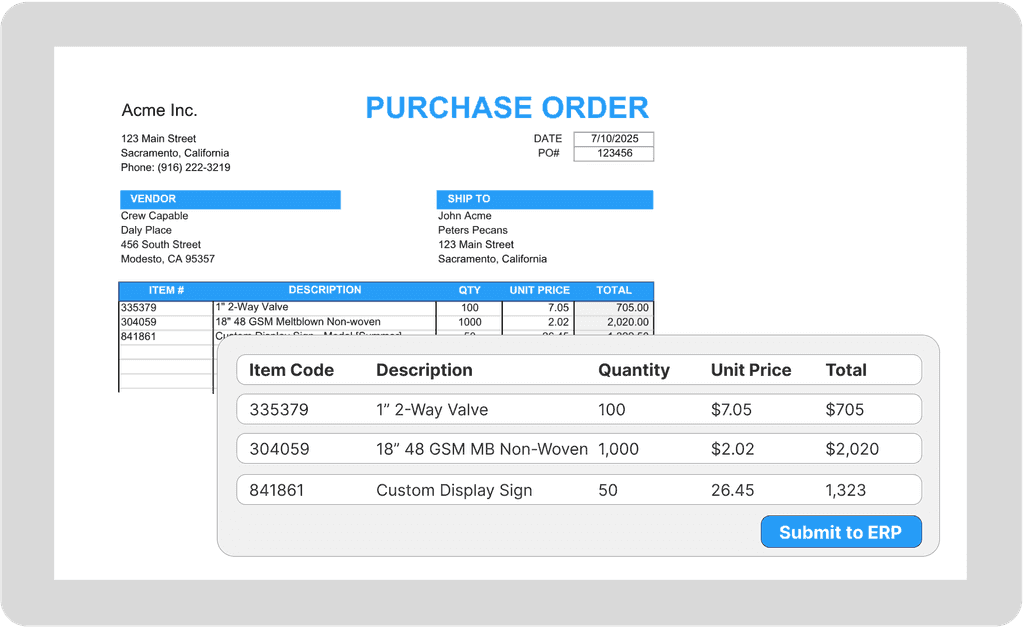
Order automation platforms like Crew Capable take a smarter approach. The system validates MOQ at order entry—before anyone thinks the order is confirmed. But instead of hard rejections, it flags for human decision: "MOQ is 25, customer ordered 15—confirm or adjust?"
This gives your team the information without taking away their judgment. Maybe this customer gets an exception. Maybe you call them to suggest adding products. Maybe you reject it. Either way, the decision happens before fulfillment, with full visibility into what's at stake.
Better automation also handles customer-specific MOQs without manual lookup. Your distributor tier gets one minimum. Retail gets another. That one account with a special agreement gets their negotiated terms. The system knows the difference because it's pulling from your customer master data, not asking your team to remember.
Crew Capable validates minimum order quantities against your customer-specific rules automatically—so violations become conversations before they become fulfillment problems.
The pattern recognition helps too. Customer usually orders 500 units, suddenly they're ordering 15? That's not just an MOQ violation—something's probably wrong with the order. AI catches these anomalies that pure rules-based automation would miss.
Stop playing MOQ police manually. Crew Capable validates minimum order quantities against your customer-specific rules automatically—flagging violations before they become fulfillment nightmares or margin erosion.