Order Entry
What is Order Entry?
Order entry is the process of getting a customer's purchase order into your system so you can actually fulfill it. Customer sends order → someone extracts the data → data goes into your ERP → order becomes shippable. Simple concept. The messiest process in most operations.
For most manufacturers and distributors, order entry means a team of people manually typing data from emails, PDFs, and spreadsheets into SAP or NetSuite or Epicor. Every. Single. Order. Eight to fifteen minutes per order when everything goes smoothly. Considerably longer when the customer uses unusual formatting, handwritten notes, or that Excel template from 2017 that nobody had the leverage to ask them to stop using.
What Order Entry Actually Looks Like
Let's walk through a real order. Your customer - a distributor based in Chicago who does decent volume with you - sends an email at 3:47 PM with an attached PDF.
Your order entry person opens the email. Opens the attachment. It's three pages - cover letter with pleasantries, the actual purchase order, and terms and conditions boilerplate. The data you need lives on page two.
They scan for the critical information:
Customer PO number (top right corner, in a box labeled "Reference #" because of course it's not labeled "PO Number" - that would be too easy)
Ship-to address (middle of the page, except the billing address is in the same font directly above it, and they've transposed these before)
Line items (table at the bottom, but the part numbers are in the customer's format, not yours - so each one needs translation)
Pricing (which may or may not match what's currently in your system for this customer's contract)
Now they type. Customer name - tab - PO number - tab - ship-to address line by line - tab. Open the product lookup in NetSuite. Search for the first part number. Not found. Right - it's the customer's part number, not yours. Minimize NetSuite, open the translation spreadsheet, search for the customer, find their part number mapping, copy your SKU, go back to NetSuite, paste it. Enter quantity. Check unit of measure - they ordered in cases, you sell in eaches, quick multiplication. Move to the next line.
Repeat for twelve line items.
Now validate pricing. Line 4 shows $47.50 per unit. Your system says $48.00. Is this an old contract price someone forgot to update? A customer error? A test to see if you're paying attention? Do you honor their price to keep the relationship smooth, or flag it and delay the order?
Enter shipping terms. Confirm payment method. Add a note about the special handling instructions that were buried in the email body, not the PDF. Hope you caught everything.
Submit. On to the next one. Forty-two more orders waiting in the queue. That's just this morning.
That's order entry at a mid-market distributor or manufacturer. Multiply by 500 orders a week. Now you understand why there are three people doing nothing but this, and why they're always behind.
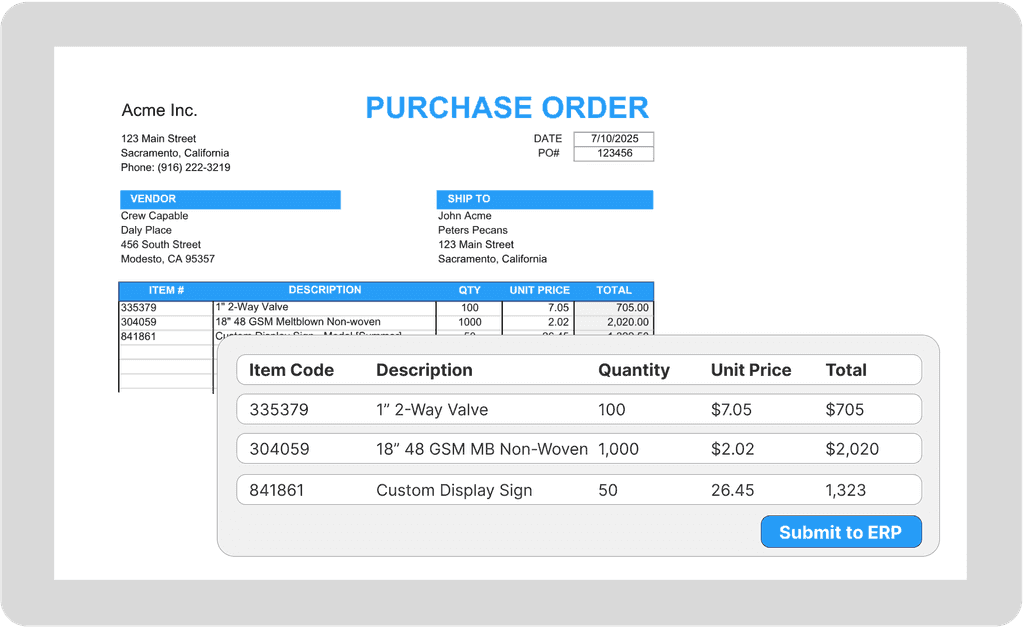
The Order Entry Bottleneck: Why Manual Processing Falls Apart at Scale
The problem isn't that your team is slow. They're probably quite good at what they do. The process itself is fundamentally broken for the volume and complexity you're dealing with.
Every order arrives differently. Same customer might send a PDF one day, Excel the next, and email body text with no attachment the third. You're not typing from a standard form with predictable fields - you're interpreting forty different formats from forty different customers, each with their own quirks and conventions.
Customers don't follow your formatting preferences. You asked for part numbers in column B. They put them in column A, or scattered throughout the document, or used descriptions instead of codes. You need ship-to addresses formatted in a specific structure. They paste it as a text block. You require PO numbers on every order for tracking. They send "see attached" or "per our conversation" or just... nothing.
Errors multiply through your operation. Wrong part number typed into the ERP? That's a wrong shipment, a return to process, a credit memo to issue, reshipment costs, and a frustrated customer. One typo during order entry creates three to five hours of downstream work across multiple departments. Multiply that by your error rate and the math gets ugly.
Hiring doesn't solve the structural problem. Order volume grows 15-20% a year for healthy companies. Hiring 20% more order entry staff means 20% more recruiting, 20% more training time before they're productive, 20% more turnover when people leave for less tedious jobs. And experienced order entry people who know your products and customers are genuinely hard to find - this isn't anyone's dream career path.
Your most valuable people are trapped typing. That customer service rep who knows your product catalog inside and out, who can upsell intelligently and solve problems and actually build relationships with customers? She's spending six hours a day copying data from PDFs into NetSuite. That's not what you hired her for. That's not where she adds value. But the orders have to get entered.
The False Solutions Everyone Tries First
We'll standardize order formats"
Every distributor and manufacturer has attempted this. Send a nice email to customers: "Dear valued partners, please use our new order template. It's attached. Just fill in the highlighted fields and email it back."
Compliance rate after six months: 30% if you're lucky. Your largest customers don't care about your template - they send orders however their procurement system generates them, and you need their business more than they need to accommodate your preferences. Your smaller customers try to comply but make formatting errors, forget required fields, or revert to old habits when the person who read your email goes on vacation.
You cannot force 200 customers with their own systems and processes to change how they operate just to make your data entry marginally easier. They have their own problems to solve.
"We'll implement EDI"
EDI - Electronic Data Interchange - works well for what it covers. Orders arrive in structured, machine-readable format. No PDF interpretation. No manual typing. Straight into your ERP.
The issue: EDI only works for the 15-20% of customers willing and able to implement it. That's your largest accounts, the ones with their own IT departments, the ones doing enough volume with you to justify the setup cost and ongoing VAN fees on their end.
Everyone else? Still sending emails and PDFs and Excel files and the occasional fax. You haven't eliminated manual order entry. You've reduced the volume somewhat while adding EDI implementation and maintenance overhead as a new operational concern. The order entry team still exists. They're just slightly less underwater.
"We'll use OCR technology"
Optical Character Recognition can read text from PDF documents. That specific capability works reasonably well on clean, high-quality documents with standard layouts.
What OCR fundamentally cannot do:
Understand that "Widget, Blue, 12in" in the customer's description is the same as SKU WDG-100-BLU in your system
Know that this customer's part number requires translation because they use their own coding scheme
Validate that the pricing on line 6 matches the contract you have on file
Handle the Excel file with merged cells and manually adjusted column widths
Parse the handwritten notes someone added to a scanned order
Adapt when a customer changes their PO format without warning
OCR addresses the "reading text from images" problem. Order entry is fundamentally an "understanding what orders mean" problem. They're related but not the same, and the gap between them is where most OCR implementations fail to deliver the promised value.
"We'll just work faster"
Pressure to increase throughput without changing the process creates more errors, not fewer. Rushing through order entry means skipping the double-check on that part number translation. It means not catching the pricing discrepancy until the invoice goes out wrong. It means transposing digits in quantities and shipping ten instead of one hundred.
Speed without accuracy is negative value. Every error created under deadline pressure takes more time to fix than the original order took to enter.
How Order Automation Actually Changes the Game
Modern order automation doesn't just read orders faster - it understands what they mean.
When an email arrives with an attached order, AI-based platforms like Crew Capable extract the order data regardless of what format the customer used. PDF attachment, Excel spreadsheet, order details typed in the email body, scanned handwritten note - the system processes them through the same intelligence. No templates to configure for each customer. No format requirements to communicate and enforce.
But extraction is just the starting point. Real automation validates what it extracts:
Part number resolution - Customer part numbers get translated to your SKUs using learned patterns. Text descriptions get matched to your catalog. Products the system doesn't recognize get flagged for human review rather than guessed at.
Pricing validation - Order pricing gets checked against your contracts and price lists. Mismatches get caught and queued for decision before they become margin erosion or awkward customer conversations.
Customer verification - Ship-to addresses get validated against records on file. Credit status gets checked. Account standing gets confirmed before the order proceeds.
Business rule enforcement - Minimum order quantities, maximum line items, shipping restrictions, product availability - whatever rules you've configured in your ERP get checked before the order arrives there.
Clean orders that pass all validations flow straight to your ERP ready for fulfillment. Orders with exceptions queue for human review - but only the exceptions that genuinely need human judgment. Your team stops spending hours on data entry and starts spending minutes on decision-making.
Stop typing orders. See how Crew Capable processes orders from any format - email, PDF, Excel, fax, handwritten, or EDI - and delivers validated data ready for your ERP. Your team handles the exceptions that need human judgment. AI handles everything else.