Alternatives to EDI for Order Processing
7 mins
Sep 19, 2025

Introduction
Your biggest customer just told you they need EDI. Not "would like" — need. Home Depot doesn't ask. Walmart doesn't negotiate. When a $50 million account says "implement EDI or lose the business," you implement EDI.
So your IT team quotes $40,000 and 6 months. You do it. You survive it. And now you've automated orders from... that one customer. Maybe two or three others who also had the leverage to demand it.
Here's what nobody mentions: your other 200 customers? The regional distributors, the local contractors, the mid-sized retailers who make up 70% of your revenue? They're not implementing EDI. They don't have EDI. They're sending emails with PDF attachments. Excel files named "PO_Final_v3_REVISED.xlsx." Phone calls expecting someone to type it in.
EDI solves the Walmart problem. It doesn't solve the order processing problem.
If that math doesn't work for you, you're not alone. Let's talk about what actually works when your customer base isn't exclusively Fortune 500 companies.
Does EDI create problems?
The setup nobody warns you about
You're looking at $5,000-25,000 per trading partner. Not total — per partner. Each connection takes 6-12 weeks to implement. Every customer needs different mapping. And then there are the VAN charges from providers like SPS Commerce or TrueCommerce that look like a phone bill from 1987. Yes, you're literally paying by the character to send orders in 2025.
Six months and $60K into your EDI project, you've automated... three customers.
And that's assuming nothing changes. Spoiler: everything changes. Mapping updates when partners change their specs. The December 23rd spec change that ruins everyone's holiday. Testing cycles that drag on for weeks while your IT team juggles fifteen other priorities.
The big customer irony
Here's the cruel irony of EDI: the customers who require it are the ones who could probably get their orders processed accurately anyway. They're sending clean, structured data. They have procurement teams who know what they're doing. Their purchase orders are immaculate.
The customers who actually cause order entry nightmares? The regional distributor who sends a PDF that's basically a screenshot of a handwritten note. The contractor who emails "same as last time but change the quantity on line 4." The family-owned business that's been your customer for 20 years and sends orders via fax because "it's always worked."
Those customers aren't implementing EDI. Ever. They don't have the systems. They don't have the IT staff. They don't have the volume to justify it. And honestly? They're not going to change how they order just because it would make your life easier.
Your biggest customers have the leverage to demand EDI. Your other customers have the leverage to take their business elsewhere if you make ordering difficult.
The 80% you're still doing manually
EDI works for Walmart. It works for Target. It works for your three biggest customers who insisted. Everyone else? Email. PDF. Excel. Phone calls. Your customer service team is still typing orders while you maintain a completely separate system for the customers who had the power to demand order automation.
Run the numbers: if your top 5 customers represent 30% of revenue but only 15% of order volume, EDI automates the easy orders and leaves you manually processing the messy ones.
EDI didn't eliminate your order entry team. It just gave them slightly fewer orders to type.
What Are the Alternatives?
Option 1: Customer portals
The pitch sounds great: build your own ordering portal and make customers enter their own orders. No manual entry needed!
The reality is less inspiring. A 10-20% adoption rate is considered "good." Your biggest customers won't use it because they have their own systems — and they're already on EDI anyway. Small and mid-sized customers forget their passwords and call to place orders instead. You're maintaining another system. And customers hate being told how to order.
Your regional distributors have been faxing orders for 15 years. They're not creating portal accounts. They're picking up the phone and saying "just put in the usual order."
Portals work as one channel. They don't work as a solution.
Option 2: OCR
Optical character recognition (OCR) reads documents and extracts text. The promise is simple: scan the PO and the data appears in your system.
But OCR is template-dependent. Every new customer format means building a new template — which means an IT project. You get 85-90% accuracy on perfect documents, which sounds good until you realize that's 10-15 errors per 100 orders. Scanned documents and handwritten notes? More like 70% accuracy. And those "exceptions" never get better. You're reviewing the same 20% of orders forever, whether you're using Kofax or ABBYY or anything else.
Your EDI customers send clean, structured data. Your other 200 customers send orders in 200 different formats. Good luck building and maintaining templates for all of them.
That's not automation. That's shifting the work from data entry to error correction.
Option 3: API integration
Direct system-to-system integration sounds ideal. Your system talks to your customer's system. Orders flow automatically with no human touch.
The catch? Both sides need modern systems with APIs. Custom development is required for each integration. And your distributor customers are running software from 2008. The maintenance burden compounds every time either side updates their system.
Here's the uncomfortable truth: the customers sophisticated enough for API integration are usually the same ones who already have EDI. You're not solving a different problem — you're solving the same problem a different way for the same 15% of customers.
Option 4: AI-powered order automation
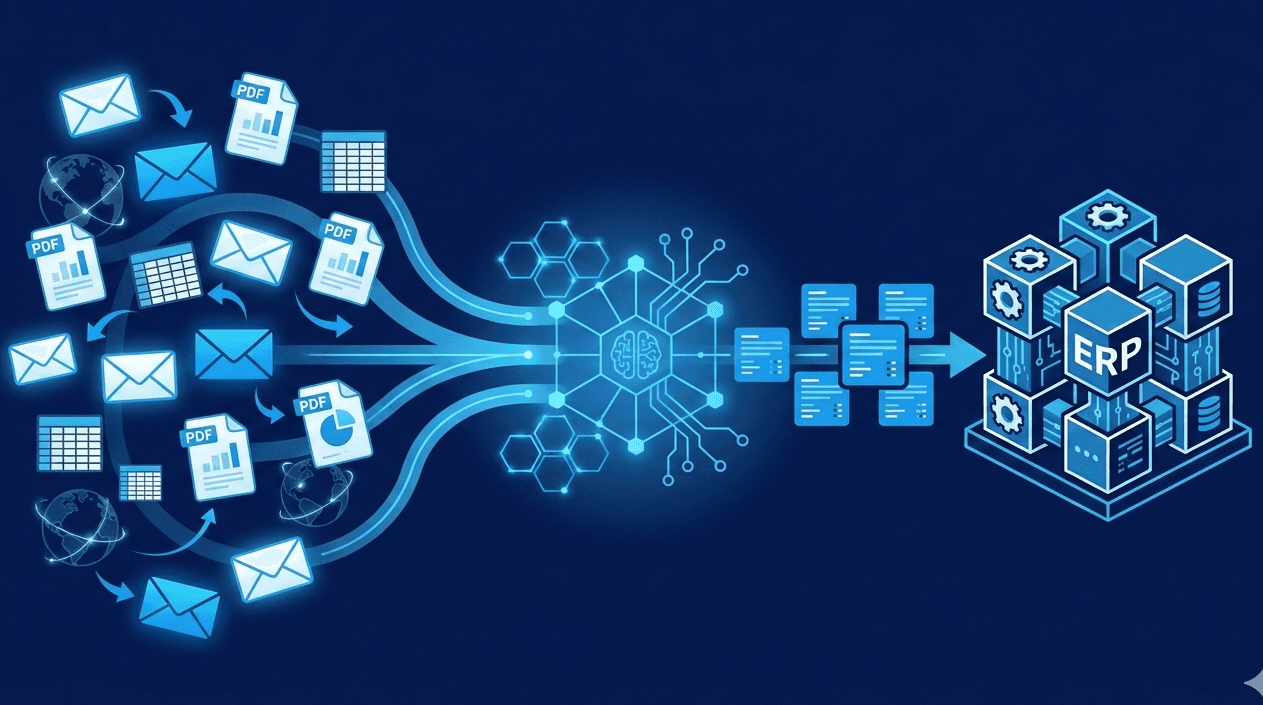
AI automation processes orders from any format — email, PDF, Excel, EDI, fax, whatever — without templates or mapping. Instead of making customers conform to your requirements, AI adapts to however they send orders.
That regional distributor with the handwritten PO? AI reads it. The contractor who emails "same as last time but 50 units instead of 40"? AI figures it out. The customer who changes their PO format every six months for no apparent reason? AI adapts without an IT project.
The system extracts data regardless of format, validates against your catalog and pricing, delivers an ERP-ready order for review, and learns from corrections to get better over time.
Modern AI platforms like Crew Capable handle the entire workflow — email integration, data extraction across any format, validation, ERP integration, and exception management. You're not maintaining templates. You're not building custom integrations. You're not telling customers to change how they order. The AI learns your business and adapts to your customers. All of them, not just the ones with enterprise systems.
Enterprise Customers vs. Everyone Else
What your big customers need
Let's be fair to EDI. For the right customers, it works beautifully.
Your Fortune 500 accounts have dedicated procurement teams, enterprise ERP systems, IT staff to manage integrations, volume that justifies setup costs, and leverage to demand you conform to their requirements. For these customers, EDI makes sense. They're sending thousands of orders. The $25K setup cost amortizes across millions in revenue. The 6-month implementation is worth it.
If your entire customer base looked like this, EDI would be the answer. But it doesn't.
What your other 90% of customers look like
Your regional distributors, local contractors, and mid-sized retailers look completely different. No procurement department — the owner's nephew handles purchasing. QuickBooks or maybe Sage 50, not SAP. No IT staff — they call their "computer guy" when the printer stops working. Order volume that doesn't justify $5K+ EDI setup. They've been ordering the same way for 20 years and it works fine for them.
These customers aren't going to change. They can't implement EDI. They won't use your portal. They're going to keep emailing PDFs and calling in orders. The question is whether you're going to keep typing them manually or find automation that meets them where they are.
Why "just get everyone on EDI" doesn't work
We've heard this from IT teams: "If we could just get all our customers on EDI, we'd be set."
Let's do the math. You have 250 active customers. Fifteen are currently on EDI — your largest accounts. Average setup cost runs $10,000 per trading partner. That's $2.35 million to get everyone on EDI, assuming they all could. Which they can't.
Half your customers would leave before they'd implement EDI. That regional distributor doing $200K annually with you isn't investing $10K in integration infrastructure. They'll just call your competitor.
EDI asks customers to change for you. Modern automation changes to fit your customers.
Do You Want to Automate 15% or 95%?
EDI automates your EDI-capable customers. That's 10-20% of volume for most mid-market companies. OCR automates the formats you've built templates for, until formats change. Portals automate the customers who bother to use them — 10-20% on a good day. AI automation handles everything: EDI, email, PDF, Excel, fax, portal, whatever customers send.
Do you want automation that works for your biggest customers, or automation that works for all your customers?
You could spend $100K and 18 months building an EDI program, an OCR library, and a customer portal. You'd automate maybe 40% of orders across three different systems. Or you could implement AI automation in weeks and handle 95% of your orders — including the EDI ones — through a single platform.
While traditional approaches require multiple systems for different order types, AI-powered platforms like Crew Capable process orders from all channels through one intelligent system. EDI transactions, email attachments, portal orders — they all flow through the same automation. Your customer sending a PDF gets the same fast, accurate processing as your customer on EDI.
Frequently Asked Questions

Still weighing EDI against the 80% of orders it won't touch? See how Crew Capable handles orders from every source — email, PDF, Excel, EDI, portal, fax — through one intelligent platform. No per-partner fees. No asking customers to change. Just orders flowing into your ERP from all your customers, not just the biggest ones.