Customer Part Number
What is a Customer Part Number?
A customer part number is whatever your customer calls a product in their system - which almost never matches what you call it in yours. Their "BWS-100-BLU" is your "WDG-ASSEMBLY-12IN-BLUE-STD." Same product, completely different language. And somewhere, someone on your team has to translate between the two every single time an order comes in.
This translation problem sits at the heart of order processing. Every order that arrives speaks your customer's language. Every order that goes into SAP, NetSuite, Epicor, or Dynamics needs to speak yours. The gap between those two languages? That's where order entry teams spend most of their time.
Why Customer Part Number Management Falls Apart
Your customer isn't trying to make your life difficult. They're sending orders using the part numbers that make sense in their system. The same part number they've been using for years. The same one that's loaded into their procurement software, printed on their shelf labels, and embedded in their buyers' muscle memory.
Here's what that looks like on your end:
Monday morning. Forty-seven orders in the inbox. Maybe half use your part numbers correctly. The rest? A mix of customer part numbers, old SKUs you discontinued two years ago, and descriptions like "blue widget, standard size" that could match six different items in your catalog.
Your order entry person opens the first PDF. Customer part number: "HW-WIDGET-7." They flip to the spreadsheet - the one Sarah maintains, the one that lives on her desktop and maybe got backed up to SharePoint last month. They find the translation: SKU WDG-100-BLU. They type it into NetSuite. Or Epicor. Or whatever system is supposed to make this easier but doesn't.
Repeat forty-six more times.
And that's assuming Sarah's spreadsheet is current. And assuming the customer hasn't changed their part number format since last quarter. And assuming nobody fat-fingers the translation while rushing through the queue before lunch.
The Cross-Reference Nightmare
Most companies manage customer part numbers through some version of "the spreadsheet." Maybe it lives in Excel. Maybe someone built a lookup table in the ERP. Maybe it's a combination of tribal knowledge, sticky notes, and that one person who just knows that Acme Industries calls everything by color first.
Anyone who's maintained these systems knows what actually happens:
The spreadsheet gets stale. New products get added without updating cross-references. Someone forgets to add the translation for the new customer you onboarded last month. The person who maintains it goes on vacation and nobody else knows the update process - or where the master file even lives.
Customers change their systems without telling you. That vendor portal upgrade they did last quarter? Now their part numbers have a new prefix. Their ERP migration last year? Different format entirely. Your spreadsheet doesn't know any of that until orders start failing.
Acquisitions compound everything. You acquired a company last year. They have their own part numbers for the same products you already stock. Now you're maintaining translations for three different numbering systems - yours, theirs, and the legacy system nobody had time to fully migrate.
Multiple formats from the same customer. Their east coast division sends orders with one format. West coast uses another. The buyer who's been there twenty years uses the old codes. The new purchasing manager uses whatever the system defaults to. All are technically correct in their world. All create translation headaches in yours.
Industry experience suggests that mid-market distributors commonly maintain tens of thousands of customer part number translations across hundreds of active customers. One distribution operations manager described their cross-reference table as "a part-time job that nobody wants." The lookup table maintenance consumed more hours than some of their actual product lines.
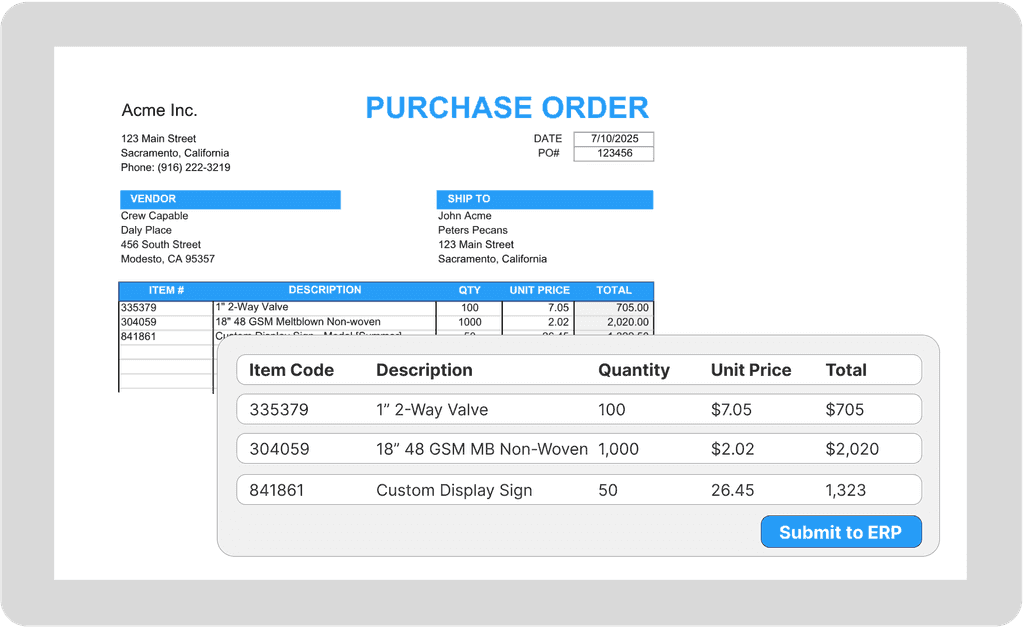
This is exactly why platforms like Crew Capable learn translations from your actual order history rather than requiring manual spreadsheet maintenance. The system builds the cross-reference dynamically from patterns in real orders.
How Order Automation Handles Customer Part Numbers
Modern automation doesn't need a perfect translation table maintained by humans. It learns the patterns from your actual orders.
AI-based platforms like Crew Capable see your historical orders - all the times "HW-WIDGET-7" got matched to SKU WDG-100-BLU - and learn the relationship automatically. When a new order comes in with that customer part number, the system already knows the translation. No spreadsheet lookup. No asking Sarah.
But here's what makes AI fundamentally different from a static lookup table: it handles variations intelligently.
Customer sends "HW WIDGET 7" with spaces instead of dashes? Still matches. They add a revision suffix like "HW-WIDGET-7-REV2"? The system flags it for review instead of breaking completely. They abbreviate "Widget" to "Wdgt" because someone was typing fast? The AI recognizes the pattern.
The translation table becomes dynamic and self-maintaining. The system keeps learning from every order your team processes. When patterns change - and they always change - the AI adapts within a few orders. You don't have to manually update a spreadsheet. You don't have to train the new person on where all the cross-reference files live.
For companies using ERPs like SAP, NetSuite, Epicor, or Microsoft Dynamics, this means the validated translation flows directly into your system. The customer's part number stays attached to the order for reference, but your ERP sees the SKU it expects.
Ready to stop maintaining spreadsheets that never stay current? See how Crew Capable learns customer part number translations automatically from your order history - no manual lookup tables, no format requirements, no translation errors hitting your ERP.